
In-Depth Explaination of Data
How Reputable Is Your Data?
As discussed in the main article, various datasets were complied by Forbes Advisor ↗ independent of this article. While conflicting opinions exist around the intentions of Forbes Advisor, independent third-party sources argue that while they may have outside factor-driven intentions to what they report (e.g. what topic to create an article on), data collected is objective and Forbes attests to their editorial team being independent. You can find more information regarding the integrity of Forbes Advisor & Forbes here ↗. All data shown in the graphs was sourced from Forbes. All graphs were independently made but mirror data that can be found in the references tab ↗.
Explaination of Figure 1: Concerns of Educator's of Student use of Artificial Intelligence in School
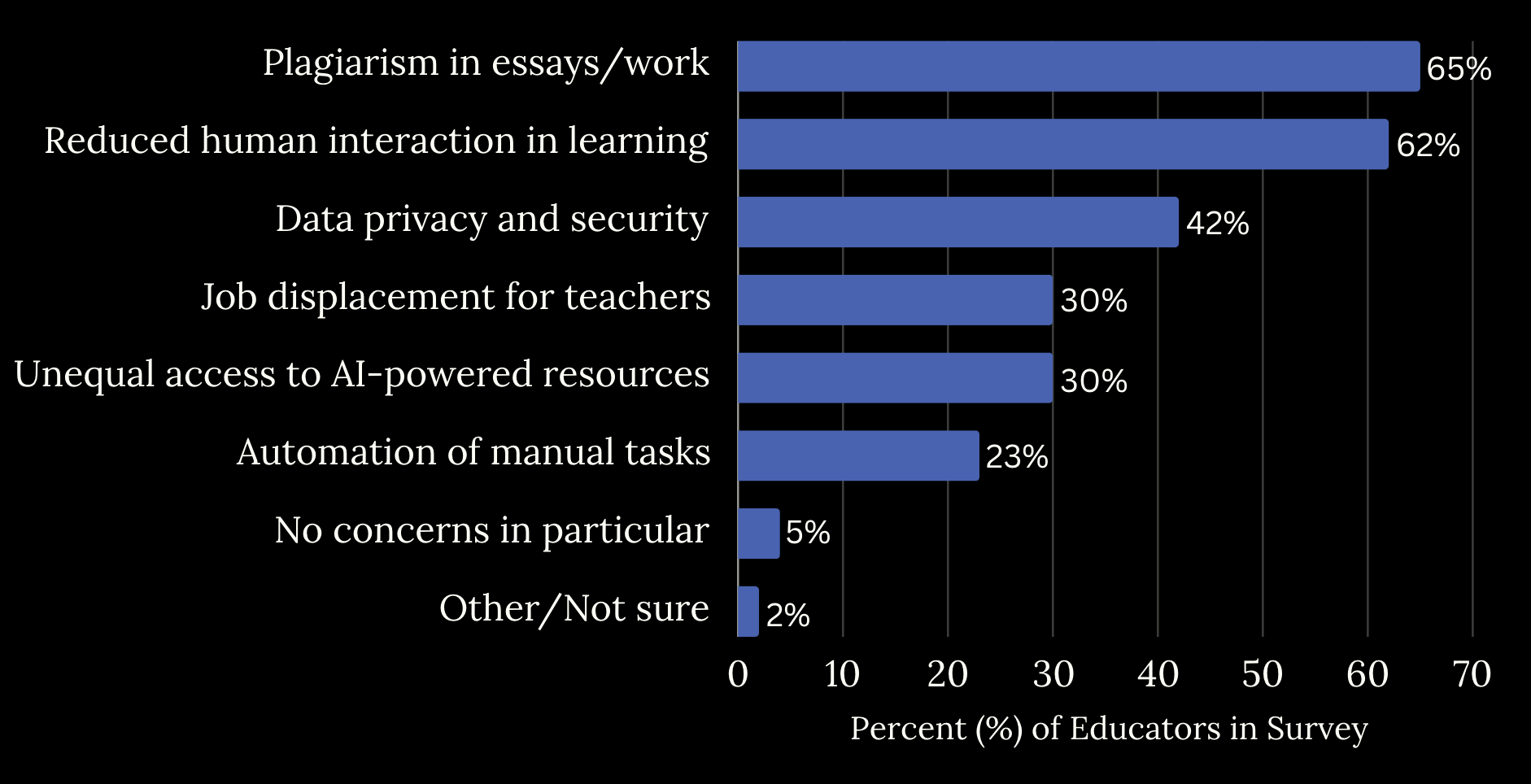
This bar graph displays the results of a survey concerning educators' concerns about the use of artificial intelligence in education. The categories of concerns are listed along the y-axis, and the corresponding percentage of educators who share each concern is represented on the x-axis. This is the breakdown of the data shown in the graph:
- Plagiarism in essays/work: 65% of educators are concerned about increased plagiarism with the use of AI.
- Reduced human interaction in learning: 62% believe that AI will decrease the amount of human interaction in education.
- Data privacy and security: 42% are worried about the implications of AI on data privacy and security.
- Job displacement for teachers: 30% fear that AI could lead to job losses among teachers.
- Unequal access to AI-powered resources: 30% worry about the disparities in accessing AI tools, leading to unequal opportunities.
- Automation of manual tasks: 23% of the surveyed educators see the automation of manual tasks as a concern.
- No concerns in particular: 5% of the respondents indicated they have no particular concerns regarding AI in education.
- Other/Not sure: 2% either have other concerns not listed or are not sure about their concerns.
The significance of the data presented in the graph is varied but prominent, reflecting deep-rooted concerns among educators about the rapid integration of AI in educational settings. These concerns signal critical areas that policymakers, technologists, and educational leaders must address to ensure that AI tools enhance rather than detract from educational experiences.
Figure 1.1: Students Plagiarizing in Essays / Work with AI (65%)
The concern about increased plagiarism with the use of AI highlights a significant challenge for maintaining academic integrity. As AI tools become more capable of generating complex texts, educators worry that students may rely on these tools instead of developing their own skills and ideas. This reliance could potentially diminish the value of original work and critical thinking, which are core to educational achievements, particularly in K-12 Education where development of critical thinking is crucial for a student.
Figure 1.2: Reduced Human Interaction in Learning (62%)
The fear that AI will decrease the amount of human interaction in educational environments is equally troubling. Human interaction is crucial for personalized learning experiences and for developing essential social skills. If AI tools replace these interactions, it could impact students' emotional and social development and weaken the bond that facilitates effective teaching and mentoring.
Figure 1.3: Concerns over Data Privacy and Security (42%)
This concern reflects broader issues with digital tools, as educators worry about how student data is managed by AI systems. The handling of sensitive information, concerns over consent, security breaches, and potential misuse are all critical issues. Ensuring robust data protection mechanisms is essential to maintain trust and safety in AI-enhanced education.
Figure 1.4: Displacement of Employement for Teachers (30%)
Approximately a third of educators are apprehensive that AI might replace human roles, which is particularly sensitive in teaching—a field deeply rooted in personal interaction, empathy, and adaptability. While AI can potentially enhance educational delivery, there is a real fear about it diminishing the teacher's role, leading to job losses and a devaluation of the profession.
Figure 1.5: Concerns over Unequal Access to AI Powered Resources (30%)
Similarly, a third of educators are concerned with the potential for AI to create or worsen disparities in educational opportunities. If AI tools and resources are not equitably distributed, students in underprivileged or rural areas may fall further behind their peers in more affluent or technologically advanced settings. Addressing this issue is crucial to prevent widening the educational gap.
Figure 1.6: Automation of Manual Tasks (23%)
Almost a fourth of educators agree that there are significant concerns about the implications of automation for controlling and personalizing educational processes. One of the primary concerns is the risk of a 'one-size-fits-all' approach. While AI can manage data and perform tasks based on predefined algorithms, it may not fully capture the nuanced needs of individual students as effectively as a human teacher can. Personalization in education is not merely about adapting to academic performance but also involves understanding students' emotional and social development, interests, and unique learning styles. AI, in its current form, might not be adept at making these fine distinctions, which could lead to a more generic and less engaging learning experience.
Explaination of Figure 2: Opinions of Educator's of Student Use of AI-Related Cheating in School
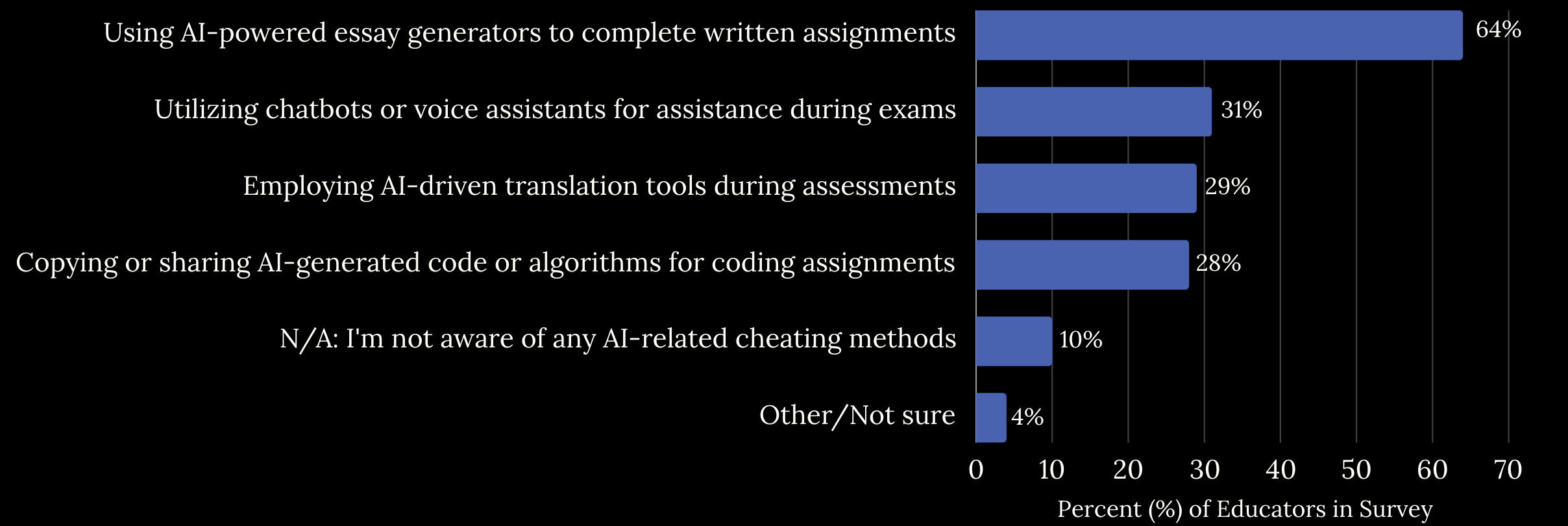
This bar graph displays the results of a survey concerning educators' awareness of AI-related cheating methods. The methods of cheating are listed along the y-axis, and the corresponding percentage of educators who are aware of each method is represented on the x-axis. This is the breakdown of the data shown in the graph:
- Using AI-powered essay generators to complete written assignments: 64% of educators are aware of this cheating method.
- Utilizing chatbots or voice assistants for assistance during exams: 31% of educators are aware of this cheating method.
- Employing AI-driven translation tools during assessments: 29% of educators are aware of this cheating method.
- Copying or sharing AI-generated code or algorithms for coding assignments: 28% of educators are aware of this cheating method.
- N/A: I'm not aware of any AI-related cheating methods: 10% of educators are not aware of any specific AI-related cheating methods.
- Other/Not sure: 4% either are aware of other methods not listed or are not sure about any.
The significance of the data presented in the graph is varied but prominent, reflecting deep-rooted concerns among educators about the possible misuse of AI in educational settings. These concerns highlight critical areas that need stringent monitoring and policies to ensure that AI tools are used ethically and enhance educational integrity.
Figure 2.1: Awareness of Using AI-powered Essay Generators (64%)
A significant majority of educators are aware that AI-powered essay generators can be misused by students to complete written assignments. This awareness is crucial for developing strategies to detect and mitigate such forms of cheating, ensuring that students engage in authentic learning experiences.
Figure 2.2: Awareness of Utilizing Chatbots or Voice Assistants During Exams (31%)
About a third of educators are aware that chatbots or voice assistants can be used by students for unauthorized assistance during exams. This highlights the need for secure testing environments that can prevent the use of such AI tools to maintain the integrity of the examination processes.
Figure 2.3: Awareness of Employing AI-driven Translation Tools During Assessments (29%)
Nearly 30% of educators are aware of the use of AI-driven translation tools during assessments. This awareness is important for addressing potential academic dishonesty in language learning environments and ensuring that assessments accurately reflect a student's own language proficiency.
Figure 2.4: Awareness of Using AI-Generated Code or Algorithms (28%)
Approximately 28% of educators are aware that students might copy or share AI-generated code or algorithms for coding assignments. This issue underscores the importance of teaching ethical programming practices and developing systems to detect and discourage the submission of non-original code.
Figure 2.5: Awareness of Not Knowing Any AI-Related Cheating Methods (10%)
10% of educators admit they are not aware of any AI-related cheating methods. This indicates a gap in understanding and awareness that could be addressed through professional development focused on emerging technologies and their potential misuse in academic settings.
Explaination of Figure 3: Educator Accounts of Beneficial Uses of AI
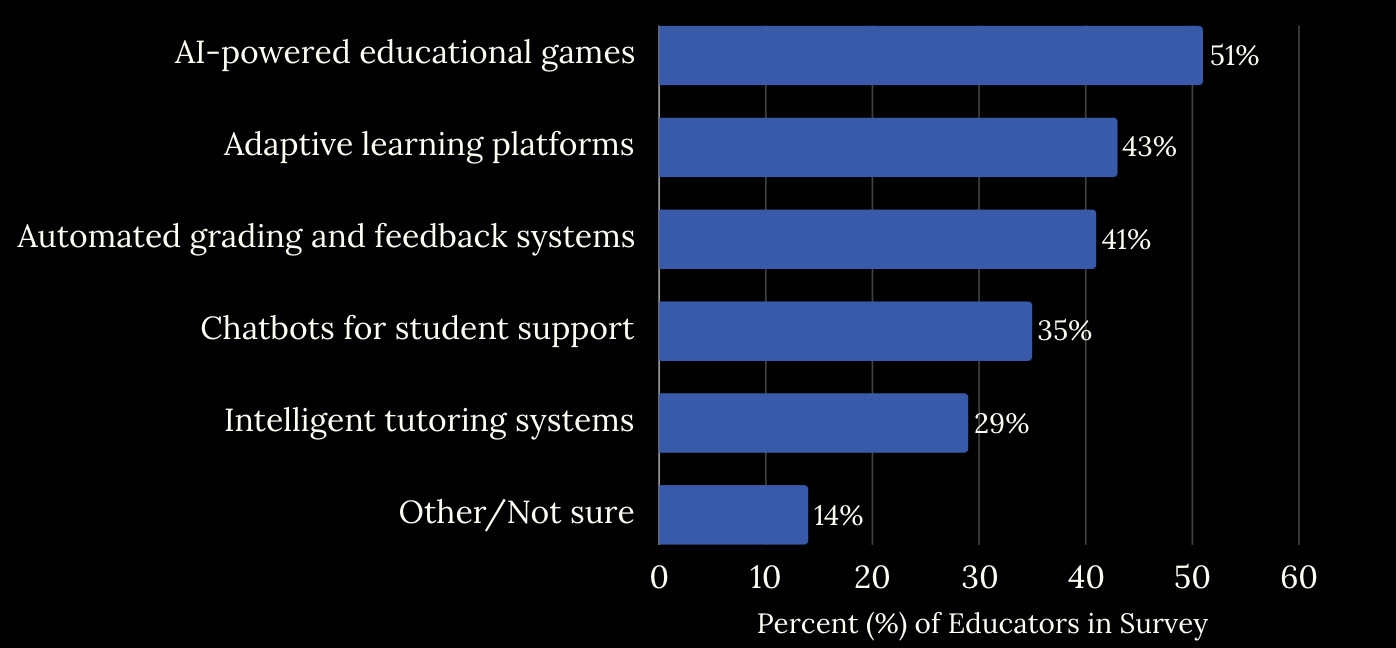
Some educators have closed the gap and are aware of how they can use AI to their advantage. Several educators have stated that they have seen or used various AI tools for educational purposes, such as AI-powered educational games or AI-powered adaptive learning systems, where the AI personalizes learning to an individual student. These tools are part of a broader spectrum of AI applications gaining traction in the educational sector.
- AI-powered educational games: 51% of educators report using AI educational games to create engaging learning environments.
- Adaptive learning platforms: 43% utilize platforms that tailor content and pacing to each student's needs.
- Automated grading and feedback systems: 41% adopt systems that automate grading and provide instant feedback.
- Chatbots for student support: 35% employ AI chatbots that offer round-the-clock assistance and streamline student queries.
- Intelligent tutoring systems: 29% implement tutoring systems that simulate personalized teaching experiences.
- Other/Not sure: 14% of educators are exploring or unsure about other AI applications.
This illustrates the various ways in which artificial intelligence is transforming the educational landscape. It highlights the adoption rates among educators for AI-powered tools and technologies such as educational games, adaptive learning platforms, automated grading systems, and chatbots for student support. Additionally, it covers the use of intelligent tutoring systems that mimic personalized teaching experiences. The list also acknowledges a segment of educators who are either exploring other potential AI applications or remain unsure about its broader implications.
Figure 3.1: AI-powered Educational Games (51%)
Over half of educators utilize AI-powered educational games, which leverage artificial intelligence to adapt the game's difficulty and content to the individual learning levels of students. This approach not only makes learning more engaging but also ensures that students are challenged just right, enhancing their learning potential and retention.
Figure 3.2: Adaptive Learning Platforms (43%)
Adaptive learning platforms are leveraged by 43% of educators. These platforms analyze student performance in real-time to dynamically adjust the difficulty and type of content presented. This personalized learning environment helps students master topics at their own pace, improving outcomes by addressing individual learning gaps.
Figure 3.3: Automated Grading and Feedback Systems (41%)
A significant portion of educators, 41%, have adopted automated grading and feedback systems. These tools can quickly assess student submissions and provide immediate, personalized feedback, drastically reducing the time educators spend on grading assignments and allowing them more time to focus on teaching and supporting students directly.
Figure 3.4: Chatbots for Student Support (35%)
Thirty-five percent of educators use chatbots to provide real-time, 24/7 support to students. These AI-powered chatbots can answer common questions, guide students through learning materials, and even provide explanations and hints when students are stuck, making learning more accessible and reducing response times significantly.
Figure 3.5: Intelligent Tutoring Systems (29%)
Nearly a third of educators are implementing intelligent tutoring systems. These systems use AI to mimic the benefits of one-on-one tutoring, providing personalized instruction and feedback based on the student's specific needs and learning patterns. They are particularly effective in subjects where students benefit from repeated practice and feedback, such as mathematics and languages.